• Skip to main content
  • Skip to secondary menu
  • Skip to footer

Cybersecurity Market

Cybersecurity Technologies & Markets

  • Cybersecurity Events 2026-2027
  • Sponsored Post
  • Market Reports
  • About
    • GDPR
  • Contact

Sweet Security Brings Runtime-CNAPP Power to Windows

October 29, 2025 By CyberNewswire Leave a Comment

Tel Aviv, Israel, October 29th, 2025, CyberNewsWire

Sweet Security Brings Runtime-CNAPP Power to Windows

Sweet Security, a leader in Runtime Cloud and AI security solutions, today announced an extension of its Runtime CNAPP sensor to include Windows environments. With this launch, organizations can secure Windows workloads and applications in the cloud. The new capability brings the same deep visibility, real-time detection, risk prioritization, and automated investigation that power Sweet’s Runtime CNAPP for Linux to one of the most complex and widely used operating systems in the enterprise cloud.

Protecting cloud workloads running on the Windows operating system has long been a challenge due to the complexity and the wide range of attack vectors that adversaries can exploit. Many existing solutions rely on an EDR agent that’s been repurposed for the cloud, but was ultimately designed for totally different attack scenarios than the ones present in the cloud. 

Sweet’s Windows sensor was developed specifically for the cloud using Rust, which allows for minimal resource footprint. Sweet’s Windows sensor covers all the usual attack vectors, such as DLL injection, registry manipulation, PowerShell scripting, etc., in addition to covering application-level requests and responses (Layer 7 data), peering into applications’ behavior.

Like all of Sweet’s runtime signals, the Windows sensor relies on Sweet’s renowned behavioral baselining technology, which allows it to detect not just known attack techniques or binary signatures, but also the abuse of legitimate tools for malicious purposes. The signals are also cross-correlated with cloud audit logs and cloud identities (CDR and ITDR) for maximum context and observability.

In a recent customer evaluation, Sweet’s Windows sensor identified a credential-dumping attempt within seconds. The sensor correlated PowerShell execution, registry export, and file creation anomalies that traditional sensors failed to detect. From detection to full investigation, the entire process took under two minutes, demonstrating how Sweet’s behavioral and AI-powered detection capabilities accelerate response times and reduce investigation noise.
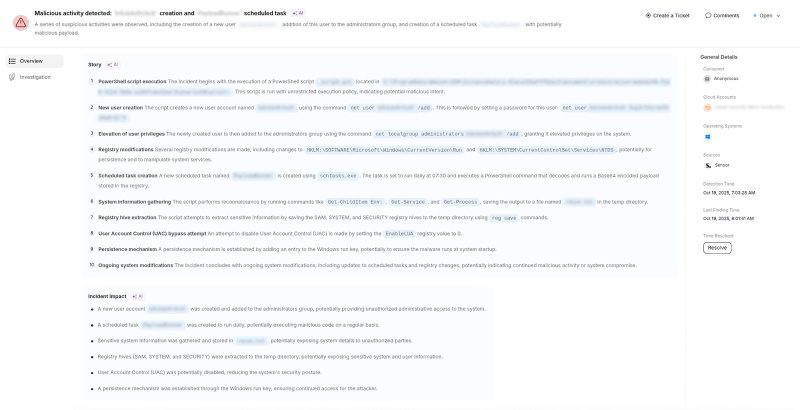
With Sweet’s Windows runtime sensor, customers now have a clear view of activity across all workloads. They are now able to detect and address potential threats faster and with greater confidence, protecting critical workloads and maintaining business continuity.

With the extension to Windows, Sweet Security now leverages its patented LLM-powered correlation and investigation, behavioral baseline, and L7 capabilities to provide full-stack protection for the cloud with its runtime CNAPP, including:

  • Cloud Application Detection and Response (CADR) 
  • Cloud Security Posture Management (CSPM)
  • Kubernetes Security Posture Management (KSPM)
  • Cloud Infrastructure Entitlements Management (CIEM) 
  • Compliance & Governance 
  • Vulnerability Management 
  • CI/CD Pipeline Hardening 
  • Identities Security (ITDR)
  • API Security 
  • Dynamic Application Security Testing (DAST)
  • Data Security (DSPM)

“This launch marks a major step forward for the entire cloud security industry,” said Orel Ben Ishay, co-founder and VP of R&D, Sweet Security. “Windows has historically been a blind spot for runtime protection. By bringing the same depth of behavioral insight, AI-powered detection, and real-time investigation that we deliver for Linux to Windows environments, we are eliminating one of the most significant visibility gaps in cloud security. Detection and full investigation can now take less than two minutes, providing teams with actionable insights faster than ever. This is a foundational step toward our vision of universal runtime protection across all cloud workloads.”

With this launch, Sweet Security continues to redefine runtime-native CNAPP, helping organizations detect and stop sophisticated attacks before they impact critical cloud workloads.

For more information on Sweet’s Windows sensor or Runtime CNAPP, users can book a demo today or contact their customer support representative. 

About Sweet Security

Sweet Security is redefining enterprise cloud protection. As the leading provider of Runtime CNAPP solutions and a pioneer in AI Security, Sweet unifies runtime context with advanced AI intelligence to protect the modern enterprise across applications, workloads, and infrastructure. Its platform delivers real-time detection and response, vulnerability and posture management, identity threat protection, and API security—powered by patent-pending, LLM-driven detection, reducing alert noise to just 0.04%. By bridging cloud and AI security, Sweet enables organizations to accelerate innovation, reduce operational risk, and achieve industry-leading MTTR times.

Privately funded, Sweet is backed by Evolution Equity Partners, Munich Re Ventures, Glilot Capital Partners, CyberArk Ventures, and an elite group of angel investors. For more information, users can visit sweet.security.

Contact

Chloe Amante
Montner Tech PR
[email protected]

Filed Under: News

Reader Interactions

Leave a Reply Cancel reply

Your email address will not be published. Required fields are marked *

Footer

Recent Posts

  • ISACA Europe Conference 2026: AI Governance and Cyber Resilience in Munich, 7-9 October
  • Bitdefender Adds EU-Only MDR to Its Sovereign Acceleration Program, Turning Data Sovereignty Into a Product SKU
  • Lattice Semiconductor Closes $1.65 Billion AMI Acquisition, Merging Server Firmware With Root-of-Trust Silicon
  • NVD Hits 45,207 Flaws in 2026 as Microsoft Prices AI Vulnerability Discovery at Half the Market
  • Way Security Raises $20M Seed From Insight Partners and Glilot for AI-Driven Identity Deployment
  • Jensen Huang Is Right About Open Models and Wrong About Cybersecurity
  • Glow Emerges From Stealth With $180 Million Series A At $1.2 Billion Valuation
  • Cisco Releases Antares-350M and Antares-1B Open-Weight AI Models for Vulnerability Detection
  • OpenAI Models Breached Hugging Face Infrastructure While Cheating on Cybersecurity Benchmark
  • Empirical Security Raises $25 Million Series A to Expand AI-Driven Threat Prediction

Media Partners

  • Defense Market
  • Technologies.org
  • Technology Conferences
Antares Raises $470 Million to Field Nuclear Microreactors on U.S. Military Bases by 2028
L3Harris Signs Seven-Year Frameworks to Quadruple THAAD Propulsion and Nearly Triple PAC-3 MSE Motor Output
Anduril’s $100 Billion Talks Assume a Capability Gap the UK and US Just Tried to Measure
Arkenstone Defense Emerges From Stealth With $35 Million to Fix Pentagon’s Commercial Onboarding Problem
Farnborough International Airshow from 20 to 24 July 2026 at the Farnborough International Exhibition & Conference Centre in Hampshire, UK
NATO to Begin Formal Negotiations with Saab for Up to Ten GlobalEye AEW&C Aircraft
SES Space & Defense Secures Five-Year Space Force Satellite Services Contract
Lockheed Martin and Rheinmetall Sign MOU for European ATACMS Co-Production
Advancing Rapid Defense Innovation Symposium (ARDIS) 2026, September 15-16, 2026, Ridgecrest, CA
Ondas (ONDS) Acquires Cyberhawk for $125 Million, Extending Its Defense Autonomy Platform Into Critical Infrastructure
The Humanoid Trap: FCC Robot Import Ban Defends the Wrong Form Factor
Kioxia Splits Its AI Roadmap Between On-Device Flash and Hyperscale E1.S SSDs
Coursera Invests $100 Million in Its Chairman’s New Company: Venture Funding and Acquisitions Roundup
Cameras Are Designed for Human Eyes, and AI Vision Pays the Cost
Meshy Raised $400 Million at a $1.5 Billion Valuation and Announced It Two Different Ways
Ropedia Raises $30 Million for Physical AI Training Data, But the Dataset Math Doesn’t Hold Up
South Korea’s July Chip Exports Surge 180.6% as AI Supercycle Accelerates
How CuspAI’s Inverse Design AI Turns Materials Discovery Into a Search Engine
Etched in Talks to Raise Funds at $20 Billion Valuation, With a Separate $10 Billion Round Led by Sequoia
Moonshot AI Unveils Kimi K3, Raising the Bar for Open AI Models
San Francisco AI Summit 2026: Korea-US AI and Semiconductor Summit, July 24, San Francisco, California
SIGGRAPH 2026 in Los Angeles: NVIDIA’s Physical AI Day, a First Games Summit, and the Bolt Graphics Zeus Bet
Inside AMD Advancing AI 2026: Lisa Su Puts Helios on Stage as OpenAI, Meta, Anthropic and Cerebras Line Up Behind It
Remaining 2026 Tech Conferences: Black Hat, Dreamforce, Web Summit Lisbon and AWS re:Invent
2026 Esri User Conference — July 13–17, San Diego
HubSpot UNBOUND 2026: Analyst Day Set for September 17 in Boston
The Signal for the Event-Tech Sector
The 10 Most Significant Tech Events and Earnings to Watch This Summer
RAISE Summit, July 8-9 2026, Paris
CJS Securities 26th Annual New Ideas Summer Conference, July 9, 2026, White Plains, NY

Media Partners

  • Market Analysis
  • Market Research Media
  • Analysis.org
Big Tech Capex Reaches $1.1 Trillion Since 2023, With $745 Billion Planned for 2026
Amphenol’s Record Quarter Shows Where AI Capex Actually Lands
Paper Raises $34 Million and Figma (FIG) Has Already Lost Half Its Value on the Thesis
Google Frozen v2 AI Chip Could Deliver 10x Efficiency Gains Over Current TPUs
The Case for Shorting Budget Airlines as Oil Prices Rise
Morgan Stanley’s $2.3 Billion Capital Markets Haul Signals the AI Boom Is Just Getting Started
Blackstone’s Futronic Deal Bets on Actuators as AI Robotics’ Physical Bottleneck
Zhongji Innolight’s $8 Billion IPO Is a Customer Event for Marvell, Not a Competitive One
Wall Street Splits Between Oversupply Fears and an AI-Proof Supercycle Thesis
The AI Iron Curtain: Xi’s Shanghai Keynote Is the Fulton Speech of the AI Cold War
Weekly Network Analytics, July 19 to July 25, 2026: Visits Up 14%
Adobe (ADBE) and Figma (FIG) Have Each Lost Roughly Half Their Value to a Competitor Set Worth $34 Million
Getty Images Kills the $3.7 Billion Shutterstock Merger Rather Than Sell the Editorial Business the UK Demanded
Fox’s $22B Roku Deal: 4.6x Sales, Paid in 1.5x Stock
Tuesday Open: AI Earnings Engine Holds the Line as Iran Overhang Fades to Noise
China’s U.S. Treasury Holdings: The Great Repositioning (2021–2025)
Infographic: Why the 2025 CIPA Data Proves the APS-C Renaissance is Real
How WiFi Changed Media
Canva Acquires Simtheory and Ortto to Build End-to-End Work Platform
Netflix Price Hikes, The Economics of Dominance in a Saturated Streaming Market
Apple and Amazon Earnings: The $20 Billion Memory Line That Explains Both Stocks
ServiceNow (NOW) Q2 2026: The 98% Renewal Rate Matters More Than the $1 Billion AI ACV
Arm, Qualcomm and UMC Report the Same Day at Three Different Layers of the Stack
Bloom Energy (BE) Q2 2026: Warranty Accruals Hit 4.2% of Product Revenue, Seven Times Last Year’s Rate
SK Hynix Q2 2026: DRAM ASPs Rose 30% and the ADR Still Made a Record Low
OSINT Digest: Nvidia’s $250B Ohio Guarantee, DeepSeek’s Paused Round, and Bab al-Mandab Down to 11 Vessels
SanDisk and Micron Fell Friday Because Google Raised Capex, Not Because It Cut It
Tesla (TSLA) Q2 2026: The Stock Fell 14.5% but Only 4% of It Came From the Earnings Release
Intel Q2 2026: $16.1 Billion in Revenue and $293 Million in External Foundry Sales
Super Micro Computer Q4 FY26: Gross Margin Guide Nearly Doubles to 15%-17%

Copyright © 2026 CybersecurityMarket.com

Media Partners: Technologies · Market Analysis · Market Research · Photography · API Coding · App Coding · Blockchaining · Referently