• Skip to main content
  • Skip to secondary menu
  • Skip to footer

Cybersecurity Market

Cybersecurity Technologies & Markets

  • Cybersecurity Events 2026-2027
  • Sponsored Post
  • Market Reports
  • About
    • GDPR
  • Contact

Gcore Radar report reveals 56% year-on-year increase in DDoS attacks

February 11, 2025 By CyberNewswire Leave a Comment

Luxembourg, February 11th, 2025, CyberNewsWire

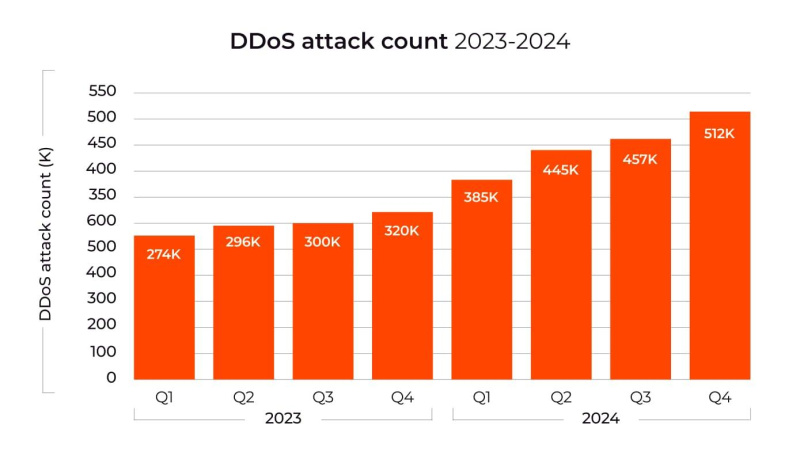
Gcore, the global edge AI, cloud, network, and security solutions provider, today announced the findings of its Q3-Q4 2024 Radar report into DDoS attack trends. DDoS attacks have reached unprecedented scale and disruption in 2024, and businesses need to act fast to protect themselves from this evolving threat. The report reveals a significant escalation in the total number of DDoS attacks and their magnitude, measured in terabits per second (Tbps).

Key highlights from Q3-Q4 2024

●    Compared to Q3–Q4 2023, the number of DDoS attacks have risen by 56%, which highlights a steep long-term growth trend.

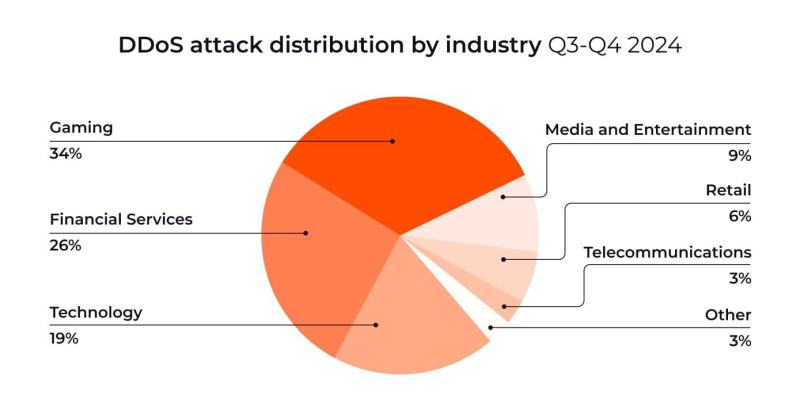
●    The gaming industry continues to be the most targeted by DDoS attacks, accounting for 34% of all attacks.

●    In Q3-Q4 2024, the financial services sector experienced a significant increase, accounting for 26% of all DDoS attacks, up from 12% in the previous period.

●    There was a 17% increase in the total number of attacks compared with Q1-Q2 2024.

●    The largest attack peaked at 2Tbps in Q3-Q4 2024, which is an 18% increase from Q1-Q2 2024.

●    DDoS attacks are becoming shorter in duration but more powerful.
Attackers are shifting their focus

The sectors that were targeted in Q3-Q4 2024 reflect a changing focus among DDoS attackers. The technology industry has seen a steady increase in its share of DDoS attacks, increasing from 7% to 19% since Q3-Q4 2023. This is because DDoS attackers recognise the wide-reaching disruption potential of attacking technology services. A single successful attack can take out a service that countless organizations depend on – causing significant harm to people and businesses. Another reason that technology platforms have seen an increase in DDoS attacks is due to their vast computational power, which malicious actors can exploit to intensify their attacks.

The gaming industry continues to be the most-attacked industry, although there were 31% fewer attacks compared with Q1-Q2 2024. The decline in attacks may be attributed to several factors. For instance, gaming companies are strengthening their DDoS defenses in response to ongoing attacks, which may result in fewer successful attacks. Another explanation is that attackers may be shifting their focus towards other high-value sectors, such as financial services, which saw a 117% increase in the number of attacks. The sector’s critical online services and susceptibility to ransom-based attacks make it a prime target.

Andrey Slastenov, Head of Security at Gcore, commented: “The latest Gcore Radar should be a wake-up call to businesses across all industries. Not only is the number and intensity of attacks increasing, but attackers are expanding the scope of their attacks to reach an increasingly wide range of sectors. Businesses must invest in robust DDoS detection, mitigation, and protection to prevent the financial and reputational impact of an attack.
The geographical distribution of DDoS attacks

With a presence that spans six continents, Gcore can accurately track the geographical sources of DDoS attacks. Gcore derives these insights from the attackers’ IP addresses and the geographic locations of the data centers where malicious traffic is targeted. 

Gcore’s findings have highlighted the Netherlands as a key source of attacks; leading application-layer attacks with 21% and ranking second for network-layer attacks at 18%. The U.S. ranked highly across both layers, reflecting its vast internet infrastructure for hackers to exploit.

Brazil featured prominently in network-layer attacks at 14%. Brazil’s growing digital economy and connectivity make it an emerging source of attacks. China and Indonesia also featured prominently, with Indonesia showing a growth in application-layer attacks at 8%, which reflects a broader trend of increased attack activity in Southeast Asia.

Short but potent attacks continue to take hold

DDoS attacks are becoming shorter in duration, but no less disruptive. The longest DDoS attack duration during Q3-Q4 2024 was five hours, which is a significant decrease from 16 hours in the first half of the year. This is reflective of an increasing trend towards shorter but more intense attacks. These ‘burst attacks’ can be more difficult to detect as they may blend in with normal traffic spikes. The delay in detection gives attackers a window of opportunity to disrupt services before cyber defenses can kick in.

The trend of shorter DDoS attack durations can in part be attributed to improvements in cybersecurity. As security tightens, attackers have learned to adapt with short burst attacks designed to bypass defenses. A short DDoS attack can also double as a smokescreen to conceal a secondary attack, such as ransomware deployment.

The full report is available at https://gcore.com/library/gcore-radar-ddos-attack-trends-q3-q4-2024

About Gcore  

Gcore is a global edge AI, cloud, network, and security solutions provider. Headquartered in Luxembourg, with a team of 600 operating from ten offices worldwide, Gcore provides solutions to global leaders in numerous industries. Gcore manages its global IT infrastructure across six continents, with one of the best network performances in Europe, Africa, and LATAM due to the average response time of 30 ms worldwide. Gcore’s network consists of 180 points of presence worldwide in reliable Tier IV and Tier III data centers, with a total network capacity exceeding 200 Tbps.

Users can learn more at gcore.com or follow them on LinkedIn, Twitter, and Facebook.

Contact

Gcore press contact
[email protected]

Filed Under: News

Reader Interactions

Leave a Reply Cancel reply

Your email address will not be published. Required fields are marked *

Footer

Recent Posts

  • International Cybersecurity Challenge 2026, May 18–21, Gold Coast, Australia
  • Bitdefender Expands GravityZone With Extended Email Security to Close the Inbox Gap
  • The Security Blind Spot Inside the Arduino-Powered IoT Boom
  • Altum Strategy Group: Cybersecurity in 2026 Is No Longer a Technology Problem
  • Trent AI and the Security Layer the Agentic Stack Has Been Missing
  • Gartner Security & Risk Management Summit, June 1–3, 2026, National Harbor, MD
  • Ashdod Port Has Blocked 134,000 Cyberattacks—and Kept Israel’s Trade Moving
  • Black Hat Asia 2026, April 23–24, Singapore
  • World Backup Day 2026: Why Recovery Has Become the Real Test of Cyber Resilience
  • Cyberhaven Launches Agentic AI Security as Shadow Agents Move Onto the Enterprise Endpoint

Media Partners

  • Defense Market
  • Technologies.org
  • Technology Conferences
ATARS Meets the M-346: Why Leonardo and Red 6 May Be Rewriting the Logic of Fighter Training
Dark Eagle: The U.S. Army’s Long-Range Hypersonic Weapon, Brief Overview
The Army Just Launched a Solicitation for a Heavier ISV — Here’s What We Know
The ISV’s $308 Million Budget Request — and Why Congress Is Pushing Back
From Prototype to Full-Rate Production: The ISV’s Development Timeline
ISV Specs and Deployment: How the Army Gets This Vehicle Into a Fight
Meet the ISV: The Army’s Lightweight Vehicle Built for Speed Over Armor
Affordable Mass: DARPA’s Push for Cheap Missiles Signals a Doctrinal Reset in Modern Warfare
Cheap Wins Wars: America’s Late Turn Toward Cost-Asymmetric Weapons
From Scrap to Supremacy: 6K Additive’s $1.95M Bet on Rebuilding the U.S. Defense Material Base
Booz Allen Backs Ulysses to Scale Autonomous Maritime Robotics
Quantum for Bio Challenge Winners Signal Real Momentum for Quantum Computing in Healthcare
Expo Raises $45 Million to Push Agentic Mobile App Development Into Production Reality
What are the reasons technology companies get acquired?
Resolve AI Raises $40 Million to Build the Missing Layer Between AI Models and Production Reality
Wayve’s $60 Million Extension Matters Because the Intelligence Stays on the Machine
Accenture Bets on Physical AI with General Robotics Investment
NanoTech Materials Raises $29.4 Million to Scale Energy-Saving and Fire-Resistant Coatings
Top 10 Emerging Technologies for 2026
The Machine That Thinks in Two Languages: Quantum Meets Supercomputing in Japan
COMPUTEX 2026, June 2–5, Taipei Nangang Exhibition Center & Taipei World Trade Center
ENGAGE 2026, April 27–28, New York
NAB Show 2026, April 18–22, Las Vegas
VivaTech 2026, June 17–20, Porte de Versailles, Paris
Accelerate 2026, May 21–22, 2026, Salt Palace Convention Center
JSNation 2026, June 11 & June 15, Amsterdam and Remote
ICMC 2026, July 30–31, Long Beach
Elevate 2026, April 22–24, 2026, Atlanta
WWDC 2026, June 8–12, Cupertino & Online
Zip Forward Europe 2026, April 16, 2026, London

Media Partners

  • Market Analysis
  • Market Research Media
  • Analysis.org
Synera’s $40M Series B: What the Press Release Isn’t Saying
Amazon’s Globalstar Acquisition Is a Spectrum War Dressed as a Satellite Deal
The End of Manual Audits: Why AI-Native Accounting Is Not Optional Anymore
Raspberry Pi’s Earnings Beat Signals a Shift From Hobbyist Hardware to Embedded Infrastructure
Betting the Backbone: A Multi-Year Positioning on AMD, Broadcom, and Nvidia
Nvidia’s Groq 3 LPX: The $20B Bet That Could Define the Inference Era
Why Arm’s New AI Chip Changes the Rules of the Game
A Map Without Hormuz: Rewiring Global Oil Flows Through Fragmented Corridors
RoboForce’s $52 Million Raise Signals That Physical AI Is Moving From Demo Stage to Industrial Scale
The Hormuz Crisis: Winners and Losers in the Global Energy Shock
Canva Acquires Simtheory and Ortto to Build End-to-End Work Platform
Netflix Price Hikes, The Economics of Dominance in a Saturated Streaming Market
America’s Brands Keep Winning Even as America Itself Slips
Kioxia’s Storage Gambit: Flash Steps Into the AI Memory Hierarchy
Mamdani Strangling New York
The Rise of Faceless Creators: Picsart Launches Persona and Storyline for AI Character-Driven Content
Apple TV Arrives on The Roku Channel, Expanding the Streaming Platform Wars
Why Attraction-Grabbing Stations Win at Tech Events
Why Nvidia Let Go of Arm, and Why It Matters Now
When the Market Wants a Story, Not Numbers: Rethinking AMD’s Q4 Selloff
Cloudflare Shares Are Poised for a Jump — Here Is Why the Setup Is Compelling
Nvidia, AMD, and Broadcom Are Rising Again — and the Market Is Telling You Something
OPEC+ in a Blocked Market: Why 200,000 Barrels Don’t Matter
Oil Shock 2026: Hormuz Risk Premium Rewrites the Curve
Why ServiceNow, Salesforce, and Atlassian Fell on the Anthropic Mythos Announcement
Broadcom’s Quiet Power Play: Strong AI Tailwinds, Yet a Stock Caught Between Cycles
Nvidia’s AI Dominance Is Real—So Why Doesn’t the Stock Feel Untouchable?
The Cost of Winning AI: Why Microsoft’s Stock Is Stuck Between Growth and Doubt
Memory Market Reality Check: Micron’s Drop Ripples Across the Sector
The Rise of China’s Hottest New Commodity: AI Tokens

Copyright © 2022 CybersecurityMarket.com

Technologies, Market Analysis & Market Research, Photography